Are you tired of endless hold times and frustrating customer service experiences? 🤔 Brace yourself for a game-changing revelation that's about to turn everything you know about customer support on its head! The AI revolution is here, and it's transforming the way businesses interact with their customers at lightning speed.
Imagine a world where you never have to repeat your issue, where support is available 24/7, and where your problems are solved before you even realize you have them. 🌟 This isn't science fiction—it's the new reality of AI-powered customer service. With 76% of support teams already investing in AI technology in 2024, the future is now. But here's the kicker: if you're not on board, you're already falling behind.
Get ready to discover how AI is not just improving customer service—it's completely redefining it. From slashing wait times to providing personalized, concierge-level support, we're about to dive into the AI revolution that's changing everything. You'll learn about the superior performance of AI over traditional methods, the key benefits it brings to customer support, and why the urgency to adopt this technology has never been greater. Don't let your business get left in the dust—it's time to embrace the AI customer service revolution!
The AI Revolution in Customer Service

A. Dramatic reduction in wait times
You've probably experienced the frustration of long wait times when seeking customer support. Traditional methods often leave you hanging on the phone or waiting days for an email response. But with AI revolutionizing customer service, those days are becoming a thing of the past.
AI-powered customer service is dramatically reducing wait times, providing you with almost instant support. Here's how:
-
24/7 Availability: AI doesn't sleep, which means you can get help anytime, day or night.
-
Automated Routine Tasks: Simple inquiries like password resets or order tracking are handled immediately.
-
Efficient Routing: AI can quickly assess your needs and direct you to the right department or agent.
-
Simultaneous Interactions: Unlike human agents, AI can handle multiple customer queries at once.
By implementing AI in customer support, businesses are seeing significant improvements in response times. You no longer have to waste precious minutes or hours waiting for assistance. Instead, you can expect near-instantaneous responses to your queries, allowing you to get back to what matters most.
B. Seamless multimodal omnichannel experience
In today's digital age, you expect to interact with businesses across various channels. AI is making this experience smoother and more cohesive than ever before. The AI revolution in customer service is bringing you a seamless multimodal omnichannel experience that adapts to your preferences and needs.
Here's what this means for you:
-
Consistency across platforms: Whether you're reaching out via email, chat, phone, or social media, AI ensures that your experience remains consistent.
-
Contextual awareness: AI remembers your previous interactions, so you don't have to repeat information when switching channels.
-
Personalized interactions: Based on your history and preferences, AI tailors the support experience to suit you best.
-
Real-time channel switching: You can start a conversation on one platform and seamlessly continue it on another without losing context.
To illustrate the impact of AI on omnichannel experiences, consider this comparison:
| Aspect | Traditional Customer Service | AI-Powered Customer Service |
|---|---|---|
| Channel Integration | Siloed, often requiring repetition of information | Seamlessly integrated, information flows across channels |
| Personalization | Limited, based on available agent knowledge | Highly personalized, drawing from vast data analysis |
| Response Time | Varies by channel, often slow | Consistent and rapid across all channels |
| Availability | Limited to business hours on most channels | 24/7 availability on all channels |
| Scalability | Constrained by human resources | Infinitely scalable to meet demand |
This seamless integration across channels means you can choose how you want to interact with a company, and AI will ensure that your experience is smooth, efficient, and personalized.
C. Proactive problem-solving and concierge-like service
AI is transforming customer service from a reactive model to a proactive one. Instead of waiting for you to encounter issues and reach out for help, AI-powered systems are now anticipating your needs and addressing potential problems before they even arise.
Here's how AI is providing you with proactive problem-solving and concierge-like service:
-
Predictive Analytics: By analyzing your behavior and usage patterns, AI can forecast potential issues and offer solutions preemptively.
-
Personalized Recommendations: AI uses your preferences and history to suggest products or services that might interest you, enhancing your overall experience.
-
Automated Account Monitoring: AI systems can keep an eye on your account activity, alerting you to unusual patterns or potential security concerns.
-
Tailored Communication: You receive personalized emails and notifications that highlight product benefits relevant to your specific needs and interests.
-
Dynamic FAQ Updates: AI continuously analyzes customer inquiries to keep FAQs up-to-date, ensuring you always have access to the most relevant information.
This proactive approach means you're not just receiving support; you're getting a personalized, concierge-like service that anticipates and meets your needs before you even express them.
Consider how this proactive AI-powered service compares to traditional reactive models:
| Feature | Reactive Service | Proactive AI Service |
|---|---|---|
| Issue Detection | Customer reports problems | AI predicts and prevents issues |
| Communication | Generic, one-size-fits-all | Personalized and tailored to individual needs |
| Product Recommendations | Based on general promotions | Customized based on user behavior and preferences |
| Support Initiation | Customer-initiated | AI-initiated based on predictive analysis |
| Problem Resolution | After issues occur | Before issues impact the customer |
By leveraging AI in this way, businesses are not just solving your problems; they're enhancing your entire customer journey. You benefit from a more personalized, efficient, and satisfying experience that feels less like traditional customer service and more like having a dedicated personal assistant.
The AI revolution in customer service is reshaping how you interact with businesses. From dramatically reduced wait times to seamless omnichannel experiences and proactive problem-solving, AI is elevating the standard of customer support to unprecedented levels.
As we've explored the transformative power of AI in customer service, it's clear that this technology is not just an incremental improvement—it's a complete paradigm shift. With this in mind, next, we'll delve into AI's superior performance over traditional methods, examining how these advanced systems are outpacing conventional customer service approaches in efficiency, accuracy, and customer satisfaction.
AI's Superior Performance Over Traditional Methods
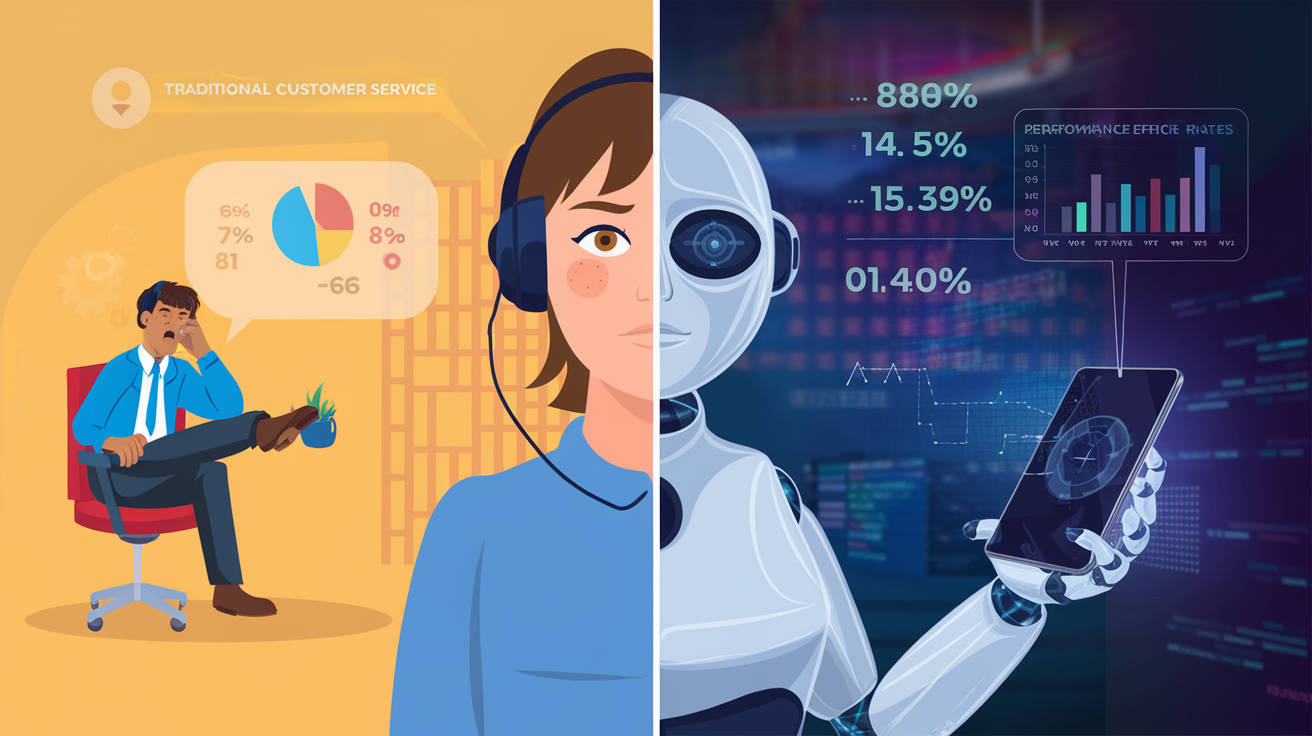
Now that we've explored the AI revolution in customer service, let's delve into how AI outperforms traditional methods, addressing key limitations and offering superior solutions.
Addressing human customer service limitations
You might be wondering how AI can truly surpass human capabilities in customer service. The truth is, while human agents excel in empathy and handling complex issues, they face certain limitations that AI can effectively overcome:
-
Consistency: Human agents may have off days or mood fluctuations, affecting service quality.
-
Availability: Unlike humans, AI doesn't need breaks or sleep, providing 24/7 support.
-
Speed: AI can process information and respond instantly, reducing wait times.
-
Scalability: AI can handle multiple queries simultaneously without compromising quality.
Zendesk's AI-powered bots demonstrate this superiority by automating over 80% of customer interactions. This automation allows you to efficiently manage complex queries across various channels, providing continuous, instant, and personalized support.
However, it's important to note that 59% of support professionals still advocate for a human-first strategy, emphasizing the importance of empathy and tailored service for complex issues. This highlights the need for a balanced approach, where you leverage AI for routine tasks while reserving human agents for situations requiring emotional intelligence.
Improved efficiency and customer satisfaction
When you implement AI in your customer service strategy, you'll notice a significant boost in efficiency and customer satisfaction. Here's how AI achieves this:
-
Instant responses: AI agents provide immediate support, eliminating long wait times.
-
Personalization: AI leverages data to offer tailored interactions, enhancing every engagement.
-
Multi-channel support: AI seamlessly handles queries across various platforms, ensuring consistency.
-
Predictive analytics: AI anticipates customer needs, allowing for proactive support.
To illustrate the impact of AI on efficiency and satisfaction, consider this comparison:
| Aspect | Traditional Methods | AI-Powered Support |
|---|---|---|
| Response Time | Minutes to hours | Instant |
| Availability | Limited to business hours | 24/7 |
| Personalization | Varies by agent | Consistent and data-driven |
| Scalability | Limited by staff size | Unlimited |
| Language Support | Depends on staff capabilities | Multilingual |
These improvements directly translate to higher customer satisfaction. By leveraging AI's intuitive design and personalization capabilities, you can enhance every customer interaction, leading to increased loyalty and positive brand perception.
Cost-effective solution with higher quality outcomes
You might be concerned about the cost of implementing AI in your customer service operations. However, AI proves to be a cost-effective solution that delivers higher quality outcomes:
-
Reduced operational costs: By automating routine tasks, you can significantly cut down on staffing expenses.
-
Minimized ticket queues: AI's efficiency in handling queries reduces backlogs, improving overall service quality.
-
Increased first-contact resolution: AI's access to vast knowledge bases enables quick and accurate problem-solving.
-
Valuable insights: AI provides comprehensive analytics, allowing you to optimize performance continually.
Here's a breakdown of how AI impacts your customer service economics:
-
Automation of 80% of interactions (as per Zendesk's AI bots)
-
Reduction in operational costs
-
Improved efficiency leading to higher customer retention
-
Minimized need for extensive human agent training
By implementing AI, you're not just cutting costs; you're investing in a solution that delivers superior results. The intuitive design of AI systems means you can adapt to diverse customer scenarios without constant oversight, further reducing your operational burden.
Moreover, AI's ability to provide instant, personalized support contributes to higher customer satisfaction rates. This improved customer experience can lead to increased customer loyalty and positive word-of-mouth, ultimately benefiting your bottom line.
It's worth noting that while 43% of organizations are investing in AI to enhance service efficiency, 57% of professionals remain unaware of these initiatives. This gap presents an opportunity for you to gain a competitive edge by embracing AI technology in your customer service strategy.
As we transition to exploring the key benefits of AI in customer support, it's clear that AI's superior performance over traditional methods is revolutionizing the customer service landscape. By addressing human limitations, improving efficiency and satisfaction, and offering a cost-effective solution with higher quality outcomes, AI is setting new standards in customer support. In the next section, we'll delve deeper into the specific benefits that make AI an indispensable tool in modern customer service operations.
Key Benefits of AI in Customer Support

Now that we've explored AI's superior performance over traditional methods in customer service, let's delve into the key benefits of AI in customer support. You'll discover how this revolutionary technology is transforming the landscape of customer interactions and support operations.
A. Increased productivity through automation
You might be wondering how AI can boost productivity in customer service. Well, the answer lies in automation. By leveraging AI, you can automate routine tasks, freeing up your human agents to focus on more complex issues. This automation leads to:
-
Faster response times
-
Efficient handling of high support demands
-
Optimized workflows
For instance, AI tools can instantly provide support for common inquiries, drastically reducing wait times for your customers. You'll find that this not only increases your team's productivity but also enhances customer satisfaction.
Here's a quick comparison of productivity with and without AI automation:
| Aspect | Without AI | With AI |
|---|---|---|
| Response Time | Minutes to hours | Seconds to minutes |
| Simultaneous Inquiries Handled | Limited by staff | Virtually unlimited |
| 24/7 Availability | Costly, if available | Always available |
| Routine Task Handling | Manual, time-consuming | Automated, instant |
By implementing AI in your customer support, you're not just increasing productivity; you're revolutionizing how your team operates.
B. Enhanced customer experiences with personalized support
You've probably heard that personalization is key in customer service. With AI, you can take personalization to a whole new level. AI tools analyze vast amounts of customer data to provide tailored support experiences. Here's how you can enhance customer experiences:
-
Personalized communications based on individual customer profiles
-
Dynamic call scripts that adapt in real-time to customer inputs
-
AI-powered recommendations for products or solutions
Imagine your customers receiving emails that highlight product benefits specifically relevant to their needs. Or consider how much more effective your support would be if your agents had AI-generated scripts that evolve as the conversation progresses.
By leveraging AI for personalization, you're not just meeting customer expectations; you're exceeding them, creating memorable interactions that foster loyalty.
C. Improved agent engagement and focus on complex tasks
You might be concerned about how AI affects your human agents. The good news is that AI significantly improves agent engagement by:
-
Alleviating mundane workloads
-
Providing tailored suggestions to guide human agents
-
Enabling agents to focus on complex, high-value tasks
With AI handling routine inquiries, your agents can dedicate their time and expertise to challenging issues that require human empathy and critical thinking. This shift not only makes their work more engaging but also allows them to develop advanced problem-solving skills.
Consider this breakdown of task allocation before and after AI implementation:
| Task Type | Before AI | After AI |
|---|---|---|
| Routine Inquiries | 70% of agent time | 10% of agent time |
| Complex Problem-Solving | 20% of agent time | 60% of agent time |
| Customer Relationship Building | 10% of agent time | 30% of agent time |
By implementing AI, you're not replacing your human agents; you're empowering them to become more effective and satisfied in their roles.
D. 24/7 support capabilities
In today's global marketplace, you can't afford to have limited support hours. AI enables you to offer round-the-clock support without the hefty costs associated with traditional 24/7 staffing. Here's how AI revolutionizes your support availability:
-
AI chatbots provide instant responses at any time
-
Automated systems handle after-hours inquiries efficiently
-
Consistent support quality regardless of time or day
With AI-powered 24/7 support, you're not just meeting customer expectations; you're setting a new standard for accessibility. Your customers will appreciate the ability to get help whenever they need it, leading to increased satisfaction and loyalty.
Moreover, AI's 24/7 capabilities extend beyond just answering questions. You can use AI to:
-
Monitor system performance continuously
-
Detect and flag issues before they escalate
-
Provide real-time updates on product or service status
By implementing AI for round-the-clock support, you're ensuring that your customers always have a reliable point of contact, regardless of time zones or holidays.
As you can see, the benefits of AI in customer support are transformative. From increased productivity and personalized experiences to improved agent engagement and 24/7 availability, AI is reshaping the customer service landscape. However, it's crucial to remember that while AI offers significant advantages, it should complement rather than replace human interaction.
With this in mind, next, we'll explore the practical aspects of implementing AI in customer service. You'll learn about the considerations and strategies for successfully integrating AI into your support operations, ensuring you can harness these benefits effectively.
Implementing AI in Customer Service

Now that we've explored the key benefits of AI in customer support, it's time to delve into the practical aspects of implementing this revolutionary technology in your customer service operations.
A. Strategic approach to integration
When it comes to implementing AI in your customer service, a strategic approach is crucial for success. You need to consider several factors to ensure a smooth integration that aligns with your business goals and customer needs.
-
Assess your current customer service landscape: Before diving into AI implementation, you should evaluate your existing processes, tools, and customer pain points. This assessment will help you identify areas where AI can make the most significant impact.
-
Define clear objectives: Establish specific goals for your AI implementation. Are you looking to reduce response times, improve customer satisfaction, or decrease operational costs? Setting clear objectives will guide your integration strategy.
-
Choose the right AI solutions: Based on your assessment and objectives, select AI technologies that best fit your needs. Consider options such as:
-
AI chatbots for handling routine inquiries
-
Natural Language Processing (NLP) tools for understanding customer intent
-
Predictive analytics for anticipating customer needs
-
AI-powered knowledge bases for self-service options
-
-
Develop a phased implementation plan: Instead of a full-scale rollout, consider a phased approach. This allows you to:
-
Test AI solutions in controlled environments
-
Gather feedback and make necessary adjustments
-
Gradually expand AI capabilities across your customer service operations
-
-
Integrate with existing systems: Ensure that your chosen AI solutions can seamlessly integrate with your current Customer Relationship Management (CRM) tools and other relevant systems. This integration is crucial for maintaining data consistency and providing a unified customer experience.
-
Train your team: Prepare your customer service staff for the integration of AI. Provide comprehensive training on how to work alongside AI tools, emphasizing that AI will complement their roles rather than replace them.
Here's a breakdown of the key components in your AI integration strategy:
| Component | Description | Importance |
|---|---|---|
| Assessment | Evaluate current processes and pain points | High |
| Goal Setting | Define clear objectives for AI implementation | High |
| Technology Selection | Choose appropriate AI solutions | High |
| Implementation Plan | Develop a phased approach for integration | Medium |
| System Integration | Ensure compatibility with existing tools | Medium |
| Staff Training | Prepare team for AI collaboration | High |
B. Overcoming challenges: resistance and security concerns
As you embark on your AI implementation journey, you're likely to encounter some challenges. Two of the most common hurdles are resistance to change and security concerns. Here's how you can address these issues:
Overcoming resistance:
-
Communicate the benefits: Clearly explain to your team how AI will enhance their work, not replace it. Highlight how AI can handle routine tasks, allowing them to focus on more complex and rewarding customer interactions.
-
Involve your team in the process: Encourage your customer service representatives to provide input on AI implementation. Their insights can be valuable in identifying areas where AI can be most effective.
-
Provide continuous support: Offer ongoing training and support to help your team adapt to new AI-powered workflows. This will boost their confidence and reduce resistance to change.
-
Showcase success stories: Share examples of successful AI implementations in customer service from other companies or departments. This can help alleviate fears and demonstrate the potential benefits.
Addressing security concerns:
-
Prioritize data protection: Implement robust security measures to protect customer data. This includes encryption, secure data storage, and regular security audits.
-
Ensure compliance: Adhere to relevant data protection regulations such as GDPR or CCPA. Make sure your AI solutions are designed with privacy in mind.
-
Transparency: Be open with your customers about how their data is being used in AI-powered interactions. Provide clear opt-out options for those who prefer not to engage with AI systems.
-
Regular testing: Conduct frequent security tests and vulnerability assessments to identify and address potential weaknesses in your AI systems.
C. Importance of human oversight and AI management roles
While AI can significantly enhance your customer service operations, human oversight remains crucial. You need to strike the right balance between AI automation and human intervention to ensure optimal customer experiences.
Establishing AI management roles:
-
AI Trainers: These team members are responsible for continuously improving AI models by providing feedback and refining responses.
-
AI Supervisors: They monitor AI interactions, identify areas for improvement, and intervene when necessary to ensure quality customer service.
-
AI Ethicists: These professionals ensure that your AI systems adhere to ethical guidelines and company values in their interactions with customers.
-
Customer Experience Analysts: They analyze data from AI interactions to identify trends, customer preferences, and areas for service improvement.
Implementing human oversight:
-
Define escalation protocols: Establish clear guidelines for when AI should hand off interactions to human agents. This ensures that complex or sensitive issues receive appropriate attention.
-
Regular performance reviews: Conduct periodic assessments of your AI systems' performance, comparing them against predefined metrics and human agent benchmarks.
-
Continuous learning: Use insights from human-AI collaborations to refine and improve your AI models over time.
-
Maintain the human touch: Ensure that customers always have the option to speak with a human agent if they prefer. This maintains a personal connection and addresses complex issues that AI may not be equipped to handle.
By implementing these strategies, you'll be well-positioned to leverage the power of AI in your customer service operations while addressing potential challenges and maintaining essential human elements. As we move forward, we'll explore the economic impact of AI on customer service, showcasing how these implementations can drive significant business value and transform your customer support from a cost center into a revenue generator.
The Economic Impact of AI on Customer Service

Now that we've explored how to implement AI in customer service, let's dive into the economic impact of this revolutionary technology. The transformation of customer support through AI is not just a technological advancement; it's a fundamental shift in how businesses approach service delivery and resource allocation.
A. Redefining service delivery without proportional headcount increase
You might be wondering how AI can help your business scale customer support without significantly increasing your workforce. The answer lies in AI's ability to disrupt the traditional linear growth model of customer service.
In the past, you'd face a challenging dilemma: choose between speed, quality customer experiences, or cost-efficiency. However, with AI, you can enhance service quality and scalability without proportionally increasing your staffing. This breakthrough allows you to:
-
Handle increased customer demand efficiently
-
Maintain high-quality support across multiple channels
-
Reduce operational costs associated with hiring and training
Consider this: AI can effectively handle approximately 80% of simple queries, freeing up your human agents to focus on more complex issues. This shift in workload distribution means you can:
-
Improve operational efficiency
-
Enhance the quality of customer interactions
-
Allocate resources more strategically
Here's a comparison of traditional vs. AI-powered customer service scaling:
| Aspect | Traditional Scaling | AI-Powered Scaling |
|---|---|---|
| Cost | Increases linearly with customer base | Remains relatively stable |
| Quality | May decrease with rapid scaling | Maintains consistency |
| Response Time | Often increases with volume | Remains fast and consistent |
| Scalability | Limited by human resources | Highly scalable |
By leveraging AI, you're not just cutting costs; you're reimagining your entire approach to customer service ROI. Instead of viewing support as a cost center, you can now see it as a driver of business value. This shift in perspective allows you to focus on metrics that truly matter, such as:
-
Price per resolution
-
Total cost of ownership
-
Customer satisfaction rates
-
AI resolution rates
B. Meeting rising customer expectations for instant, round-the-clock support
You're likely aware that today's customers demand instant, 24/7 support. AI enables you to meet these expectations without breaking the bank or overworking your staff. Here's how:
-
Instant responses: AI-powered chatbots and virtual assistants can provide immediate answers to customer queries, reducing wait times and improving satisfaction.
-
24/7 availability: Unlike human agents, AI doesn't need sleep or breaks, ensuring your customers can get help whenever they need it.
-
Consistent quality: AI maintains a consistent level of service quality, regardless of the time of day or volume of inquiries.
-
Personalized solutions: By analyzing customer data, AI can offer tailored recommendations and solutions, enhancing the overall customer experience.
These capabilities translate into tangible benefits for your business:
-
Higher customer satisfaction (CSAT) scores
-
Improved first-contact resolution rates
-
Reduced average handling time (AHT)
-
Enhanced customer loyalty and retention
Let's look at a real-world example: Bank of America's AI chatbot, Erica, has facilitated over 1.5 billion client interactions since its launch. This impressive figure demonstrates the scale at which AI can operate, handling a volume of interactions that would be impossible for a human team alone.
C. Creating new roles and skill sets within support teams
As you integrate AI into your customer service operations, you'll find that it doesn't just replace tasks—it creates new opportunities for your team. This shift leads to the emergence of new roles and the need for enhanced skill sets:
-
AI trainers and supervisors: Your team members can evolve into roles that involve training AI systems and overseeing their performance.
-
Complex problem solvers: With AI handling routine queries, your agents can focus on solving more intricate customer issues, requiring higher-level thinking and creativity.
-
Customer experience strategists: Your staff can take on more strategic roles, analyzing AI-generated insights to improve overall customer experience.
-
AI-human collaboration specialists: New positions may emerge that focus on optimizing the interaction between AI systems and human agents.
To support this evolution, you'll need to invest in upskilling and reskilling your workforce. This investment brings several benefits:
-
Increased job satisfaction and employee retention
-
Higher-value contributions from your team
-
Improved ability to handle complex customer needs
-
Enhanced overall service quality
Here's a breakdown of how AI impacts different aspects of your support team:
| Aspect | Impact of AI |
|---|---|
| Routine Tasks | Automated, freeing up human resources |
| Complex Issues | Handled by skilled human agents |
| Data Analysis | Enhanced by AI insights |
| Training | Focused on AI collaboration and advanced problem-solving |
| Career Paths | Diversified, with new specializations emerging |
By embracing these changes, you're not just adapting to a new technology—you're positioning your business for sustainable growth in an AI-driven future.
As we look ahead to the urgency of AI adoption, it's clear that the economic impact of AI on customer service is profound and far-reaching. You've seen how it redefines service delivery, meets rising customer expectations, and creates new opportunities within your support teams. The question now is not whether to adopt AI, but how quickly and effectively you can integrate it into your customer service strategy to stay competitive in an increasingly AI-driven marketplace.
The Urgency of AI Adoption

Now that we've explored the economic impact of AI on customer service, it's crucial to understand the urgency of AI adoption in this field. The landscape is rapidly evolving, and businesses that delay implementation risk falling behind their competitors. Let's delve into why adopting AI in customer service is not just beneficial, but imperative for your business success.
A. Rapidly closing window for competitive advantage
You're operating in a market where the window for gaining a competitive edge through AI adoption is swiftly narrowing. The statistics paint a clear picture of this urgency:
-
By 2032, the call center AI market is projected to reach a staggering $6 billion.
-
Customer expectations are skyrocketing, with 63% demanding quicker responses and 57% seeking faster resolutions.
-
The US is leading the charge in customer experience (CX) automation, with 27% of businesses prioritizing it highly.
These figures underscore the rapid pace at which AI is transforming the customer service landscape. You can't afford to be left behind in this AI revolution. Early adopters are already reaping the benefits:
-
74% of businesses are utilizing chatbots, the most common AI application in customer service.
-
29% have implemented more advanced conversational AI systems.
| AI Adoption Metrics | Percentage |
|---|---|
| Businesses using chatbots | 74% |
| Businesses using conversational AI | 29% |
| US businesses prioritizing CX automation | 27% |
The message is clear: if you're not already incorporating AI into your customer service strategy, you're likely falling behind your competitors. The longer you wait, the harder it will be to catch up and differentiate your service offering.
B. Phased approach for implementation
You might be feeling overwhelmed by the prospect of overhauling your customer service with AI. However, you don't need to implement everything at once. A phased approach can help you integrate AI smoothly and effectively:
-
Start with chatbots: Begin by implementing AI-powered chatbots to handle simple, repetitive queries. This can immediately alleviate pressure on your human agents and provide 24/7 customer availability.
-
Expand to conversational AI: As you become more comfortable with AI, transition to more sophisticated conversational AI systems that can handle more complex interactions.
-
Integrate with CRM systems: Enhance personalization by connecting your AI systems with your customer relationship management tools.
-
Implement sentiment analysis: Use AI to analyze customer sentiment in real-time, allowing you to prioritize and escalate issues as needed.
-
Develop proactive assistance: Leverage AI to predict customer needs based on behavior patterns and provide proactive support.
Remember, 77% of agents cite data quality and availability as a major challenge in AI implementation. As you progress through these phases, focus on improving your data infrastructure to support more advanced AI applications.
C. Evolving customer perceptions and attitudes towards AI
You need to be aware that customer attitudes towards AI in customer service are changing rapidly. Understanding these shifts is crucial for successfully implementing AI in your customer service strategy:
-
Growing acceptance: While 90% of customers still prefer human agents over chatbots, there's a noticeable trend towards AI acceptance, especially among younger consumers.
-
Industry-specific expectations: In retail, for instance, 78% of businesses believe consumers would welcome AI assistance. You need to gauge the expectations in your specific industry.
-
Balancing AI and human touch: Despite the push for AI, 78% of CX leaders believe human agents remain irreplaceable. Your strategy should focus on using AI to augment human capabilities rather than replace them entirely.
-
Changing skill requirements: As AI takes over routine tasks, you'll need to retrain your human agents to work alongside AI systems, focusing on more complex problem-solving and empathy-driven interactions.
-
Ethical considerations: As you implement AI, be mindful of ethical concerns. Transparency about AI use and ensuring fair, unbiased interactions are crucial for maintaining customer trust.
To illustrate the evolving landscape, consider these contrasting perspectives:
| Stakeholder | Positive View on AI Effectiveness |
|---|---|
| C-level executives | 61% |
| Customer service agents | 45% |
This disparity highlights the need for you to manage expectations and perceptions across all levels of your organization as you implement AI solutions.
As you navigate this rapidly evolving landscape, remember that the goal is to enhance, not replace, human-driven customer service. By adopting a phased approach, staying attuned to customer attitudes, and focusing on the synergy between AI and human agents, you can position your business at the forefront of the customer service revolution.
The urgency is clear: AI adoption in customer service is no longer a luxury but a necessity. With customer expectations rising, competition intensifying, and technology advancing at breakneck speed, you can't afford to delay. Start your AI implementation journey now, and you'll be well-positioned to deliver superior customer experiences that drive loyalty and business growth in the AI-powered future of customer service.

The AI revolution in customer service is not a distant future—it's happening now. As we've explored, AI is transforming the landscape with superior performance, reduced wait times, and seamless multimodal experiences. The economic impact is undeniable, with AI redefining service delivery economics and enabling better support without proportional headcount increases.
You can't afford to wait. With 79% of teams forecasting further AI investment in 2025, the window for gaining a competitive advantage is closing rapidly. Embrace this AI hack to revolutionize your customer service. Start by implementing AI in high-impact areas like query automation and team productivity enhancement. As you progress, explore advanced capabilities such as predictive analytics and AI copilots. Remember, this transformation isn't just about technology—it's about meeting evolving customer expectations and empowering your support team with new skills and roles. Act decisively now to stay ahead in the customer service game.
Comments
Post a Comment